
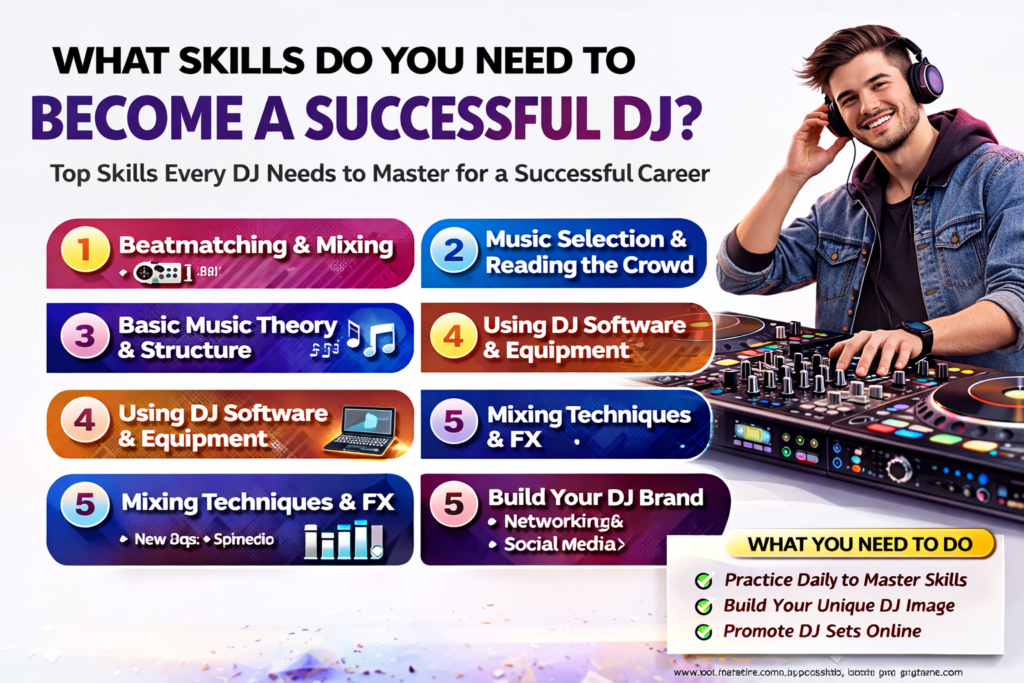
Becoming a successful DJ doesn’t just mean playing music, but rather creating changing experiences for your audience. He or she should be able to ‘read the room’, manage the mood, and blend musical tracks seamlessly. It is important to develop essential skills as a DJ whether at a club, wedding, or a festival for growth. Technical issues can occur at any point, and the chance to rectify such problems manually is often instrumental in salvaging a show/performance, proper learning through a DJ manual inculcates necessary skills required for beatmatching, mixing, and handling of equipment, a balanced in volume level is also of utmost essence in creating a well-balanced and pleasurable sound scheme.
The overall experience may be either amplified or diminished with too much or too less volume. Technical knowledge, creativity, and consistent practice help one in developing one’s unique style and confidence; Concentrate on using your manual and managing sound as these are critical to successful performances as a DJ.
Strong Understanding of Music
Fundamental to DJing is the knowledge of music. There is a need to understand various genres of songs, beats, tempos, and structures. This helps in ‘reading the crowd’ successfully. For instance, a DJ doesn’t just pick popular songs to play; he needs to know how one track leads into another. The decision to drop a beat or change the genre hinges on one’s ability to analyze music. Manual techniques such as beatmatching by ear (instead of using software) improve musical instincts significantly.
Beatmatching and Mixing Skills
The skill of beatmatching is one of the most basic DJ competencies. The first “Beatmatching” concept is one of the most basic DJ skills: it’s about syncing the tempo (BPM) of two tracks so they run smoothly together. Even though most modern DJ softwares have auto-sync functions, limiting one’s self to using these can impair one’s progress. Mastering manual beatmatching enables the DJ to deal with unforeseen situations, especially when changing equipment. Equally important is the volume levels between tracks. Too much or too little volume at certain stops can affect the flow and can spoil the listener’s experience. A professional DJ will also ensure that there is never a jump or drop in volume which ruins the transition and the listener’s experience.
Equipment Knowledge
The DJ equipment needs to be understood because all DJ controllers and turntables and mixers require users to know their operational details. This includes; Equalizer (bass, mids, trebles) Crossfader operation Gain and volume controls; A DJ who predominantly relies on manual controls on an equipment can be effective for making quick adjustments in a live scenario.
Reading the Crowd
One of the critical skills that a DJ can possess is the power to read the crowd. You need to know what the people want in the room even if they do not say it. Are they dancing? Is their energy draining? They are asking whether they prefer fast-paced music or slower and more relaxed music. ? Adjusting the playlist and volume levels accordingly on crowd response is key. For example; High energy crowd – tempo and volume to be enhanced slightly; Relaxed vibe → smoother tracks with volume under control. Such an adjustment is both an intuition and an experience.
Creativity and Unique Style
To appeal as a DJ, one has to have a personal style. One can choose songs to be played but cannot set a certain mood or feeling that his/her selection of songs create. Creativity you can develop in the following ways; Trying different mixes Putting effects like reverb and echo Remixing with manual controls.The combination of creative work and correct volume control will enable your properly adjusted effects to produce authentic musical content that maintains its original form.
The combination of technical abilities and software expertise
DJs in the present day use Serato and Rekordbox and Traktor DJing software as their primary tools for performance. For: Library management; Cue points; Applying effects; However, manual backup skills should never be underestimated. This familiarity with manual or semi-manual operation constitutes a significant advantage, given that technology can and will fail. Also, volume calibration in the software prohibits distortion and ensures the maintenance of sound quality.
Time Management and Preparation
Preparation is essential in a DJ performance. That is to; Pre-set your playlists; Analyze for bpm and key Check your equipment. DJing is spontaneous, but having a manual plan helps you feel more confident while performing your set. The sound check process requires permanent volume assessment which will prevent unexpected changes from occurring during live shows.
The development of communication abilities together with networking competencies
A DJ achieves success through music and networking which creates opportunities to connect with event organizers and club owners and other DJs. Effective communication gives you insights into: Expectations of the Events Type of audience Sound requirements, including restrictions on volume levels. Professionalism and flexibility will allow one to obtain a lot of gigs for the DJ.
Confidence and Stage Presence
Your energy is transmitted directly to the crowd. Confidence in a DJ keeps the audience on the edge of their seats. Simple things like; Crowd interaction Grooving to the beat (Ibid; Volume flow; would enhance your performance; In case of mishaps, manual control skills are so strong that you recover without the crowd knowing what happened.
Consistent Practice
Like any skill, DJing requires practice at all times. Enjoy your time: Transitions practice Trying out new genres of music; Manual improvements. You also have to work on volume-balancing your mixes. 4) Listen to Your Mixes.
Conclusion
Becoming a successful DJ is a matter of technical knowledge, creativity and people skills. From the manual controls, to knowing how to control the volume of sounds, every component is important in giving a great show. After becoming a DJ, one still has to continue learning. They develop new trends without breaking their unique styles. You can learn a lot of the skills mentioned in this article, which together with constant practice, will give you a good basis for a successful DJ career. DJ is not about the process of playing music rather it is about creating moments for people that stay with them long after the music has stopped.